
Starting your teaching journey
Course Structure
In terms of workload, we suggest the following for a 2-day module (on campus format, 2.5 ECTS):
- Pre-Module Phase: 10-15 hrs of preparation for the students (pre-module assignment)
- Core-Module Phase: two full days of teaching in the classroom, typically from 8:30 – 17:30 (including breaks)
- Post-Module Phase: 10-15 hrs for the students working on post-module assignments
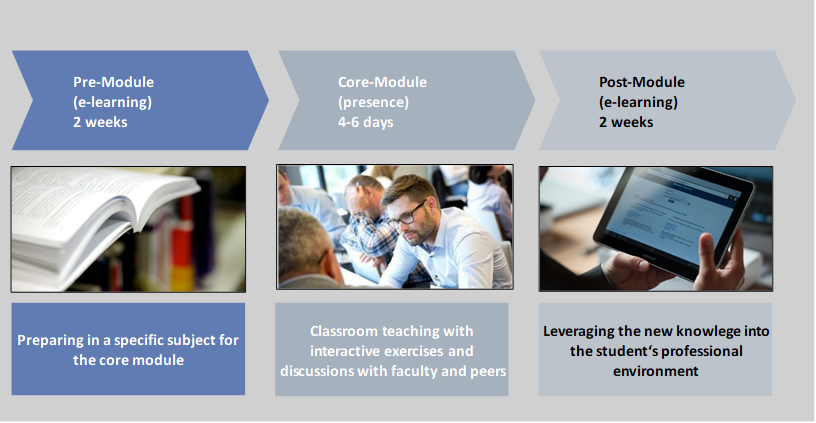
In the pre-module phase, students immerse themselves into the preparatory materials such as readings, cases etc. that you assign for them to prepare. You can assign either individual or group assignments or both depending on what you find relevant for the students to come to class well-prepared. Approximately two weeks are scheduled for the pre-module period. E-Books, books, reading packages and case studies for students are included in the tuition fee. Students receive them in advance, at the core-module preceding your module.
- Keep in mind that our students are working fulltime, so be clear and specific in defining the assignments you want students to work on.
- If you need students to have read and know content you are assigning for the pre-module phase, make sure you connect it to an assignment that is graded. It is not uncommon for recommended (instead of required) material to be disregarded due to time pressure.
- Recommended material is still highly appreciated! Students differ in their interest for certain topics, their time management and ambition – adding value through your suggestions as an expert on how to take the content further, is very well received.
- Your program manager provides you with the student roster – this allows you to cater your material and assignment to each cohort.
- If you want to see, how you can connect your teaching to our values, checkout this page for inspiration.
Your Core-Module will usually last either two or four days of teaching from 8:30 to 17:30 (with 15 min breaks in the morning and afternoon, approx. 1 hr lunch break) on campus. Your program manager will share details with you for the specific program you are teaching in. The core-module is also assessed based on the participation students show (see also Assessment & Grading).
Tipps:
- Variatio delectat or Variety delights. To make your teaching successful, you are encouraged to utilize various pedagogical approaches during a module, such as group presentations, individual and/or group case work, case discussions and traditional lecture-discussions. Check out our Toolbox for inspiration.
- Please stick to the break times, as our catering and service team works on a tight schedule.
- Your IT environment in the WU Executive Academy Classrooms allows you to bring in guest speakers to the classroom virtually – so you can invite your network contacts to the classroom and enrich the classroom discussion. In the section “During your teaching journey” you find more details on the IT set-up in our classrooms.
- Our Teaching Support Team is happy to share best practices and work with you on your didactical requirements (See also: Your contacts@WU Executive Academy).
At the end of each core-module, you provide a post-module assignment for the students. It is your decision, if this should be done as individual or group work. Such assignments may include the completion of projects/cases and the delivery of essays/reports on certain topics addressed in the course of the module. Ideally, the post-module should have a high level of practical relevance to ensure a smooth application of knowledge to the work environment of the participants. Similar to the pre-module assignment, two weeks are scheduled for the post-module period.
Tipps:
- The post-module assignment is a good tool to connect to our values. In various reflection formats, you can ask students to connect their goals to your class content (see also: Connecting your teaching to our values).
The timeline for your teaching journey
To make your preparations easy and for us to support you seamlessly, working along a timeline is of tremendous help. While there might be deviations due to specific program set-ups (e.g., PMBA – hybrid track), here is what you can typically expect:
About 1 year to 18 months in advance:
-
- We contact you to suggest teaching dates and you confirm your availability. This procedure works for programs which are already established and for you, if you have been teaching at WU Executive Academy before. Shorter time frames may apply (e.g., for new programs, faculty replacement)
About 4 months in advance:
-
- Your program manager shares with you the syllabus template with your confirmed teaching dates.
- You also receive last time’s student feedback, and information on any changes that may have occurred.
- You will also receive the student profiles – a handout with names and pictures of each student. In class, there will be name tags.
- You will be contacted regarding travel arrangements.
About 2 months in advance:
-
- Your syllabus is shared with the Academic Directors for feedback and approval.
- The course structure including all assignments is implemented it into our Learning Management System (LMS).
- We order books, cases, other material etc for the students.
About 1 month in advance:
-
- Your program manager is contacting you with a questionnaire to identify the technical and didactic requirements for your teaching.
- Find the questionnaire for hybrid and in class teaching here. Find the questionnaire for online teaching here.
- Our Teaching Support Team will arrange a virtual meeting with you to go through your requirements.
The day before:
-
- If you want to test your equipment or the lecture room set-up, the Teaching Support Team is happy to help – please arrange for a meeting with them before your core-module. Lecture room – 360° view
Tipps:
- Sticking to the timeline is THE key success factor for your teaching journey! It allows us to do our work at the quality level we aim to deliver and for the students to come to class prepared.
- The time line for the teaching material is important, as we need to hand out any physical material at least one module before yours so that students can take home their materials for preparation.
- Doing a virtual meeting with our Teaching Support Team is another key success factor for your teaching journey! Our Teaching Support Team consists not only of IT-, but also didactical experts AND they know everything about our teaching facilities. Sharing your ideas and technical set-up with them, will help you to see what is possible and how => do take this opportunity seriously, even if you have taught at the WU Executive Academy before, as software set-ups, technical requirements etc. change and we can continously share our best didactical practices with you (see also: hybrid teaching@WU Executive Academy).
- You can prepare yourself in advance by learning more about our teaching facilities, the options in Moodle and helpful didactical tools like the EA Toolbox or Zoom.
- Please bear in mind that the students already know each other quite well after the teambuilding sessions at the beginning of the program, so that they find recurring rounds of introduction in class usually rather unnecessary.
Connecting your teaching to our values
For everything we do – including our teaching – we have identified three core values that guide our doing. In the following, we outline each value and provide suggestions on how you can connect your teaching to our values throughout the course structure.

Foster Individuality
We support our students on their individual learning journey and contribute to the goals they set for themselves, their companies, and the societies they live in. In many of our programs, students start off by setting their own goals for their learning journey (e.g., in a “Letter to myself”, a learning diary) to make the journey as INDIVIDUAL to them as possible.
- Encourage them to keep these goals in mind, as they go along. Connecting content and topics with their individual goals helps them to leverage their learnings in a way that is meaningful to them.
- Provide students with ample opportunities to reflect on the content and thoughts you share with them in the classroom, either individually e.g., in reflection papers, peer-to-peer reflection or other interactive formats.
- You may also set time aside in each module for a few minutes to allow them to draw the connection between your teaching and what is relevant to their INDIVIDUAL learning journey.
- You could incorporate a reflection paper into the post-module assignment, which is by the way a great way to learn in-depth how and what in your teaching resonated strongly with students beyond the regular class evaluations.
- … and of course YOUR feedback on student work – while we know this is work-intensive, it is an amazing way for FOSTERING INDIVIDUALITY, where you as an experienced educator share your insights with the student.
You know that learners have their individual learning styles – some prefer reading, others listening or viewing. As they all have their business schedules and personal obligations, they appreciate your creativity in providing content.
- Most of our programs are set up as blended-learning formats with on-campus and off-campus elements.
- We appreciate variety in content provision from articles, websites, podcasts, videos you created yourself or identified online (or even co-created with us, depending on the program), computer-based simulations, and many more interactive preparation and teaching elements.
- Out of experience, we know that our students fall into two major categories:
- Those who cannot learn enough – are happy with additional readings, books, materials, and suggestions that YOU curated because you find them relevant to your topic.
- And others who want to get straight to the point, knowing what to do and prepare for a module and what is expected.
- BOTH student types appreciate that
- detailed and clear instructions are outlined in a Comprehensive syllabus which you provide as EARLY as possible.
We take great care to make sure that our students have an amazing experience during their time with the WU Executive Academy.
- Therefore, we spend a lot of time in consulting them to identify the right program.
- Get on board as seamlessly as possible.
- And make the most out of their learning journey beyond the classroom.
- FOSTERING INDIVIDUALITY therefore means supporting not only the learning journey itself, but also through a portfolio of personal and career development activities that we offer to our students.
- Alongside their studies, students are consulted by the Community Engagement Team.
- Our strong ties to our students and among them lead to a vibrant alumni community with over 4.500 alumni in more than 60 countries.
- It allows staying connected and foster individual career and personal development support beyond the day of graduation.

Cherish Diversity
We strongly believe that diversity (in terms of nationalities, industries, functions, gender, age, etc.) enriches the learning environment invaluably. Therefore, we put a strong effort into recruiting students from as diverse backgrounds as possible. To leverage and foster this diversity in our learning initiatives, we encourage you to incorporate the following ideas.
- In selecting teaching material, examples, and anecdotes for the classroom environment, setting up teams for group work, etc. make sure that you actively cater to this diversity.
- This also means to step in proactively, if you detect disrespectful behavior by students inside and outside the classroom. Remember: you are a role model for the students, and SILENCE MEANS CONSENT.
- Diversity is also reflected in different teaching and communication styles – a multi-facted didactical set-up that allows learners to learn in their own way and to contribute in their own way (not only extrovert but introvert students) will add tremendously to the classroom experience.
With a strong, multi-disciplinary university in the background, we encourage taking different perspectives and bringing in different ideas in the learning setting.

Break new Grounds
Our world of today and tomorrow is complex and unpredictable. Next to solid business know-how, this requires pioneer qualities. We support our participants in unleashing them within themselves.
- We foster cooperation over competition and collaboration over lone fighters. The way you set up your assignments and evaluate student work verbally and in your grading strongly fosters this spirit.
- The classroom is a learning environment, where students should be able to have a safe space, where they share their experiences and thoughts, and where they can experiment.
- Transferring learning at all levels into the students’ professional practice ascertains that your teaching has an impact. Use multiple ways to encourage the implementation of new knowledge into the student’s daily life. Our toolbox may provide new didactic tools and input for you. (See also: Moodle or online teaching@WU Executive Academy).
Harrassment Policy
WU Vienna has an institutionalized system to address conflicts, complaints, or other study-related concerns (e.g., Wirtschaftsuniversität Wien: Ombuds Office for Students – Student Support – Service Units (wu.ac.at)). The Ombuds Office addresses among other topics incidents of inappropriate behaviour, discrimination, (sexual) harassment or violence. Next to the WU Ombuds Office, WU Executive Academy students may also approach the Office of the Austrian Student Ombudsman (Ombudsstelle für Studierende an Universitäten & Hochschulen (hochschulombudsstelle.at)).
In addition to formal institutional support, students find relevant information in the Code of Conduct, integrated into the onboarding process for each program through the Student Guide. It highlights routes available to students in the face of assault and harassment.
If you experience such situations, the program managers frequently serve as the initial point of contact for such concerns. Collaborating with the Academic Director and/or Dean, they develop appropriate measures and advice, emphasizing formal policies and procedures.
To mitigate the occurrence of such events, we focus attention during onboarding, team-building, and all responsible leadership initiatives to communicate that such behaviour is unacceptable and will not be tolerated.
If you have any observations/concerns, please do not hesitate to contact us!